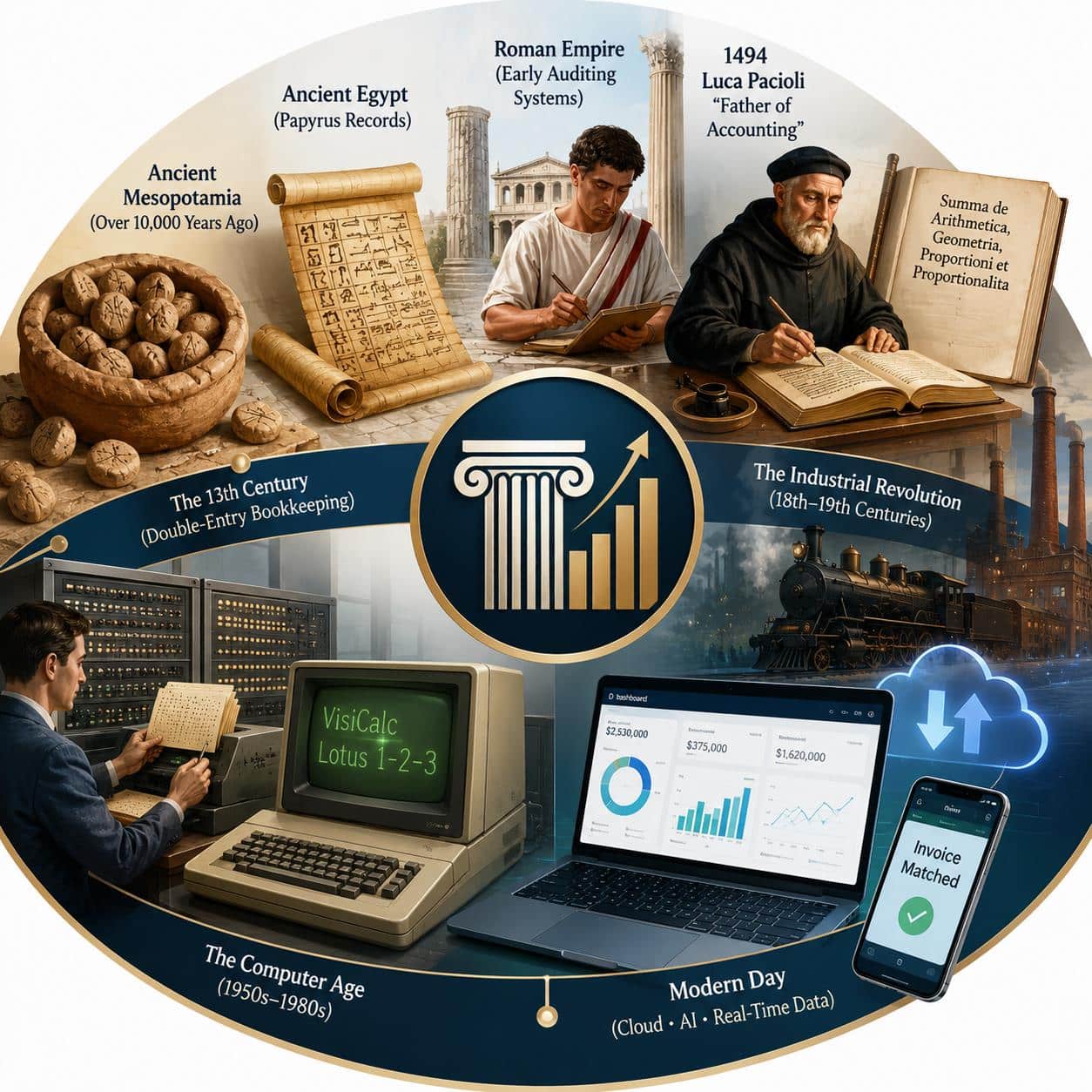
Accounting‘s roots stretch back over 10,000 years to ancient Mesopotamia, where merchants used clay tokens in bullas to track traded goods. This record-keeping evolved through the use of papyrus in Egypt and early auditing systems in the Roman Empire. Modern accounting is built on these early foundations and continues to adapt to the needs of global commerce.
The formalization of the modern practice is divided into several key eras:
- The 13th Century: Double-entry bookkeeping (recording debits and credits) first emerged in Italian city-states to track complex commercial transactions.
- 1494: Italian mathematician and Franciscan friar Luca Pacioli published Summa de Arithmetica, Geometria, Proportioni et Proportionalita. By codifying the double-entry system, he earned the title “Father of Accounting”.
- The Industrial Revolution (18th–19th Centuries): The rise of massive corporations and railroads necessitated standardized financial reporting to attract investors. This era birthed the modern accountancy profession and professional certifications.
- The Computer Age (1950s–1980s): Accounting transitioned to computers, utilizing punch cards, early mainframes, and eventually spreadsheet software like VisiCalc and Lotus 1-2-3.
- Modern Day: Modern accounting uses cloud technology, automation, and artificial intelligence to streamline financial management, improve accuracy and efficiency, and provide businesses with real-time insights for better decision-making.